
Information About Fishing for Bluefish and Bass
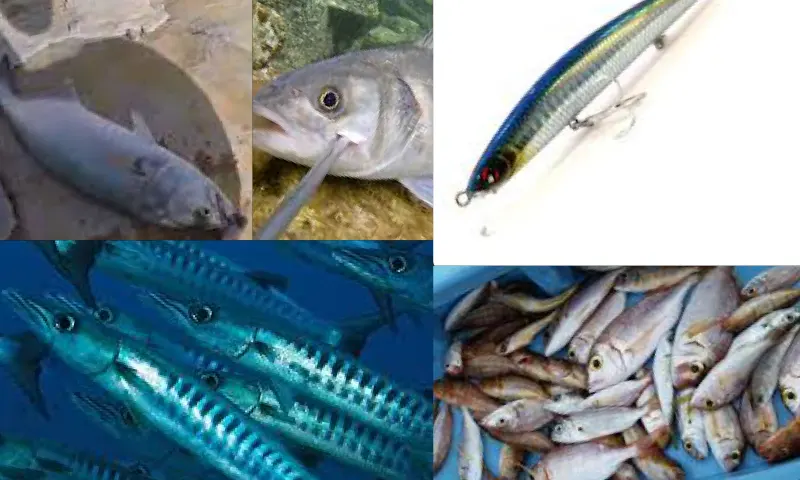
Fishing for bluefish and bass is one of the most challenging and enjoyable types of fishing in the Mediterranean. We practice fishing with the method called "at-çek" (cast and retrieve), and our most important equipment for this method is our spinning rods. Spinning rods of 2.50 cm or 2.80 cm are the most useful for bluefish and bass fishing. However, the rod must be a carbon rod so that the arms do not get tired during continuous casting. Reels of size 50-60 with 4-5 ball bearings and a rear drag should be used. Rear drag reels are more practical than front drag reels for catching large fish. Aluminum body reels should be used for "at-çek" style fishing because they have no body weight.
Aluminum body reels should be used for "at-çek" style fishing because they have no body weight.
Now let's discuss lure selection. Lures can be made of silicone, and there are also lipped lures with rattling balls that resemble fish. The most important thing is that the size and color of the lure should match the color and size of the fish that the bass and bluefish are preying on. Choppy waters are the hunting grounds for predatory fish, and fishing is done here by observing the habits of the feeding grounds. That is, while a bass might strike a silicone lure in area A, it might strike a white, red-headed rapala in area B, and even strike a spoon or another colored lure that moves on the surface in different weather conditions. For this reason, you need to have high-quality, predatory lures in different colors and that swim at different depths. Lures have a long plastic piece at the mouth part; the longer this piece is, the deeper the lure dives. Some make a splashing sound, while others make noise with the balls inside, which attracts attention. If the fish are on the surface, a floating type lure is used; if they are deep, a diving type rapala is used. My advice to friends who will be practicing "at-çek" fishing is to work with two types: surface and deep diving, with white and silver-blue colored rapalas, and not to venture into other colors too much. This is because water clarity, turbidity, waves, or whether it is evening or morning water all differ. Sometimes, an orange-colored lure being effective does not mean it will be effective in another feeding ground; therefore, using diving and surface lures in general standard colors is more reliable. Live bait is not used in "at-çek" fishing, but "at-çek" can also be done with a "shak shak" rig, also known as "ak yem" (white bait), prepared by leaving the head part of the fish and using a stolen rig with a hook.